Category: Articles

  • Making a Morning Schedule

    Making a Morning Schedule

    This post was originally written on August, 11th 2010 on my blog SFPSMom.com Check out my blog for more parenting tips.

    Making a Morning Schedule

    You are probably already working with a morning routine. I created one last year when my girls were in Pre-K. This year, though, I’ve asked my daughters to get involved in creating a written Morning Schedule. As my girls are getting older, I am seeing that they want to express their emerging sense of independence and sometimes resist following my routine. (The pre- pre- pre-teen years have begun!)

    Though it would be much easier for me to just do it myself, I decided to use the big transition to kindergarten as an opportunity to start teaching my girls a “big girl” skill of time management. Getting them involved in the process will have the added benefit of reducing resistance to mommy’s rules. This is the schedule they helped to create (See right.)

    Making a Morning Schedule

    Brainstorm Ideas

    Talk about the tasks we do each day to get ready for school, and wrote them down on sticky notes. I made it fun and silly by suggesting ridiculous tasks. Since they can’t read, I drew stick figure illustrations. If your child likes acting, you could also pretend to be a little kid, and your child can be the parent and give you advice on what to do.

    Talk about the Value of Time

    Group tasks into roughly 15 – 30 minute chunks (e.g. wash face, brush teeth, potty, could fit into a 15-minute chunk). Many children (and even teens) struggle to learn basic time management skills because they don’t fully understand the value of time. (e.g. how long is a minute, five minutes, an hour? What does it feel like? What types of activities fit into these time amounts?) 

    Create a Master Schedule

    Create a big grid to put our tasks into and explain how a schedule works and how much time you have. I used an old manila folder cut in half glued to an oversized piece of construction paper. (See our version above. If you have another good version please email me and I’ll upload it as well.)

    Add/rearrange tasks

    Decide how to order the tasks. Tell your child “time management” means “fitting the tasks you have to do into the time you have”. With your child, take the sticky notes and fit them into the schedule you created. Have fun by making some silly suggestions that obviously don’t work. For example, ask “Do you think you should brush your teeth, and then eat breakfast? Or the other way around?”. Ask  your child what he or she thinks makes the most sense and what his or her preferences are for the order of tasks (obviously within reason.) Explain how much time you think activities will realistically take and agree to keep working on the schedule until you get it right.

    Decorate

    Let your child decorate the schedule with stickers and glitter glue, or go online to find superheroes or favorite characters to print out and glue on the calendar. Post your Morning Schedule in a prominent place you can point to in the morning. It is also helpful if it is near a clock. That way, you can reinforce your child’s learning of both how to read time and also their awareness of the value of time (as mentioned above.)

    Celebrate! 

    If you’ve already got a reward system, find a way to fit your Morning Schedule into it. If you don’t already have something in place, I find stickers or stamps are a great reward unto themselves. Also, never underestimate the power of hugs, high-fives, and fist-bashes!

    Some other ideas to consider

    Make it a game 

    are a good strategy for slowpokes. You can play with a timer and make a game out of doing various tasks. Just make sure it’s FUN and doesn’t increase stress. If you can find a silly time (we have a frog) it can help.

    You can ask: “How long does it take to get dressed? brush our teeth? How long does a favorite episode of your show last?”

    Use Music

    Make a music playlist that goes along with some of your morning activities. Great songs to include are upbeat, like “At the Hop” or “Move It Move It” or those with lyrics that count down). Let them know that they should be getting shoes on by a certain song.

    Let them chose

    If your child likes to be independent, let them choose the order of activities in a section of your schedule each day. For example: brushing teeth, going potty, washing face, and brushing hair could all go in the category of “grooming”. Your child could do “grooming” at the same time each day, but pick a different order for each activity every time.

    Whatever strategies you choose, the most important move is to HAVE FUN with these ideas, and approach it as a process. Each and every family is different, and so our our kids! 

    On that note, I’d like to know what YOU are doing to help make morning routines go more smoothly. What are your ideas? What works for you? If you come up with a twist or adaptation you’d like to share, please post a comment, or email me a picture and I’ll post it to the blog!

    If you found this post informative, please share it with other families. Thank you!

    Related Reads:

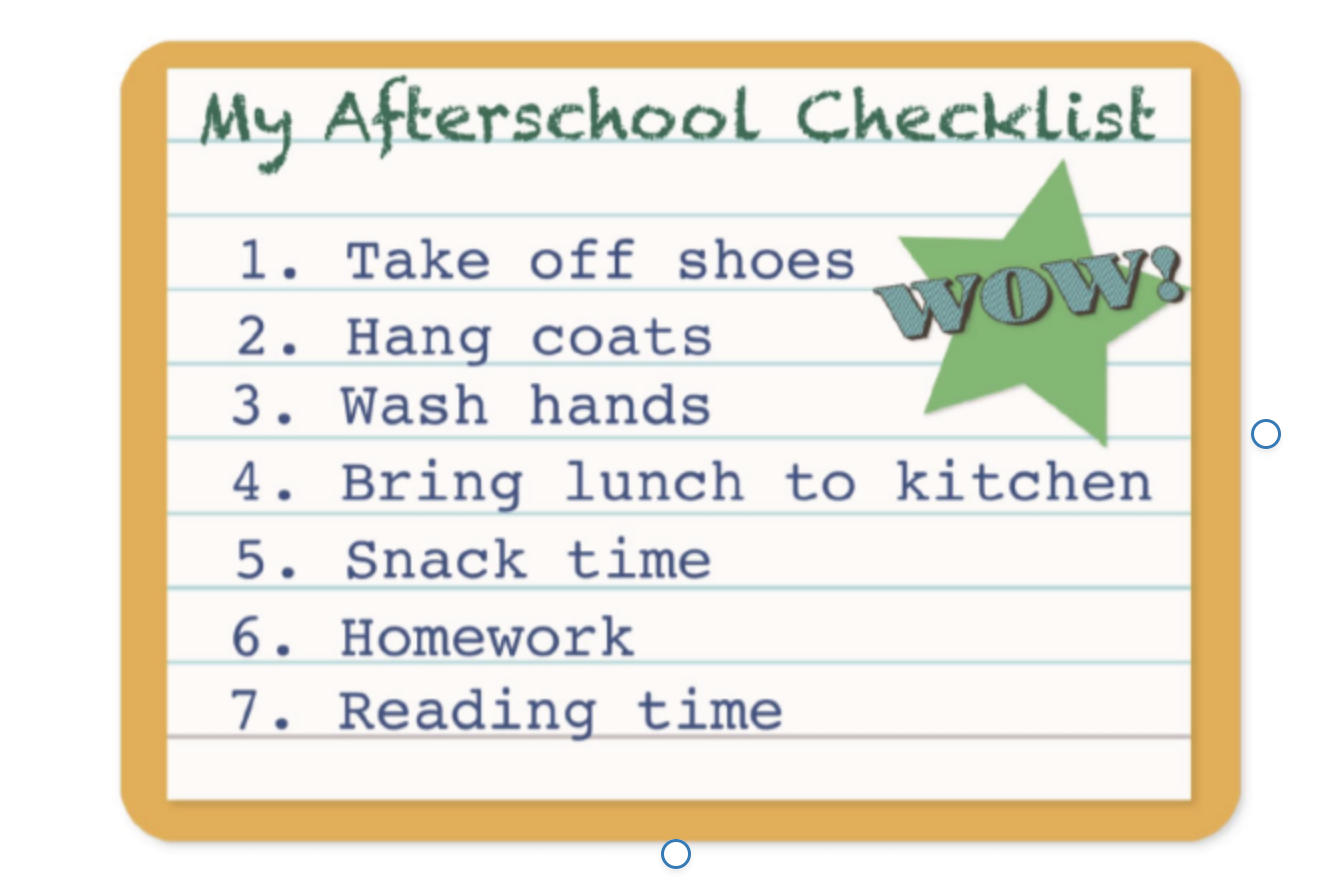
    Checklists to Keep Your Family On Track – Use these FREE Printable Checklists to help getting to bed, in from school, and out the door in the morning!

  • And Suddenly, There’s A Math Book (You Already Know)

    And Suddenly, There’s A Math Book (You Already Know)

    This is a repost from The JLV.

    Note: This is a reminder that, if you became a paid subscriber to Jose’s blog, you’ll get a signed copy of You Already Know! If you’d like to support this scholar, join his newsletter here.


    Remember when I told you I’d need a timeout so I could write a book? Welp, it’s almost here and I’m so excited to share how we got here!

    Believe it or not, it starts where it ends. In early February of 2020, I had a call with an editor about a potential math book. She said, “Jose, but I’m not a math editor.” I said, “Exactly.” I didn’t want to write the typical content-area book. We have plenty of examples of great math books, but few that discuss underlying principles and who we’re doing this work for. In other words, if the math book hit for a person who didn’t see themselves as a math content expert, then I’ve written the book I wanted in the world.

    But then two life-altering things happened back-to-back: an acceptance letter to Teachers College, Columbia University to pursue my doctorate and a global pandemic arriving on American shores. In the midst of a personal win, I quickly felt the immense wave of losses. As degrees of separation between me and people who died from COVID passed, I also saw my classes physically slipping away. Some people’s memories, including Robert F. Kennedy Jr.’s, may be short, but more of us remember the harrowing images and numbers of people we lost. I became the bearer and receiver of bad news weekly.

    And then there was this book. 

    I was fiddling with ideas in a proposal. The words came in chunks, not flows. One of my first proposals felt like I threw papier-mâché on my walls. “Here’s what I want to say to families.” “Here’s what I might say to non-math educators.” This all happened while reading about Marx, Engels, and Weber, turning in theoretical papers deep in the trenches of my mind, but distant from the lived realities of people away from the centers of academia. People asked me to make meaning of education amidst human rights rebellions in the street, social depression among our youth, and political turmoil.

    I willingly obliged them because I, like so many of us, needed to rise to the occasion. As always. But then this book.

    This book may get marketed as “by a teacher for teachers,” but underneath it lies ulterior motives. As I’m breezing through earlier proposals and drafts I submitted, I’m trying to address people who consider themselves “non-math” people. What even is a math person? Many of us who teach math were more often than not the winners of a system that, at each stage of our K-12 journey, treats math like a sifter until only the finest powder makes it through. That’s one way of creating a society, but does it point towards an authentic democracy? 

    No, definitely not. Where too many people concentrate strictly on outcomes, I see there’s a need to talk about how we got here. It isn’t just standardized testing. It’s a complete disregard of civilizations since time immemorial. Our concepts of zero, our units of measurement (because customary is just awful), and our math more generally came to the present through political and structural means. Which math mattered and for who has always been up for debate. What shouldn’t be up for debate is whether our students come from communities that use math on multiple fronts.

    The book hopefully solves for that, too.

    And so the title You Already Know emerges from that idea. I’ve talked to you about ideas, but ultimately, here are some things worth knowing:

    • I don’t remember when it was over until it was.
    • There were multiple eyes on it at different points of the process, but ultimately, the writing and composition all came from within me.
    • I could have kept writing. Even before we had to turn it into the printer, I still had minor revisions and edits I wanted to make.

    You’re getting my best (up to this point) ideas about the math I learned and who I learned it from. As most of the country’s PK-12 students have already started classes, this book hopefully arrives just when you either feel bored, stymied, or in need of a reminder of the math teacher you want to be for your students. The book even comes with a short framework for how to do the work:

    You Already Know is organized around five core principles of responsive math pedagogy:

    • use what students already know
    • allow more mistakes
    • support students’ struggle
    • let students teach, too
    • answer questions with more questions

    I’m also seeing how this book comes just weeks before more potential civil unrest in the form of midterm elections. While federal and local forces attempt to take a hatchet to governance, I also wish for this book to help carve the way forward. It should stand as testament that someone said and did something to concretize the work of teachers. As someone who’s taught so many students of different backgrounds, I believe we’re ten toes down on responsiveness to our students and communities, too.

    But you already knew that. I know you did.

    Jose

  • The Curriculum Of Bad Bunny At The Super Bowl Halftime Show

    The Curriculum Of Bad Bunny At The Super Bowl Halftime Show

    BY JOSE VILSON | FEBRUARY 17, 2026

    “¿Esto lo que tu queria?”

    The scene with Bad Bunny in the Spike Lee-inspired Double Dolly shot was the wink to the audience that pulled his Super Bowl half-time show together. For those who haven’t watched any of Lee’s most prized cinematic works (Malcolm X, 25th Hour, Crooklyn, to name a few), the shot serves an important purpose. Rather than the more passive viewing of the film, the double dolly forces the viewer to sit with the protagonist’s stream of consciousness. 

    For educators who watched, it might feel difficult to peer through this 13-minute sample of Bad Bunny’s art in this way. As with any piece of this kind, accessibility and cultural translation matter just as much as language translation. In this case, Bad Bunny takes the opportunity to open a window into his process for the show. The violinists break from the raucous “EoO” into a melodramatic “Monaco,” a song in which Bad Bunny discusses the gift and curse of rising to fame. He addresses his fans (“I’m here at Super Bowl 60 because I never stopped believing in myself. You, too, should believe in yourself. It matters more than you think.”) and his dissidents (“Is this what you wanted?”).

    But you’re not supposed to turn into Bad Bunny in the classroom. You’re supposed to learn how to see. That’s the difference.

    The transition to a wedding singer in which Lady Gaga plays wedding singer for a couple’s nuptials elevates the conceit. The halftime show, akin to Kendrick Lamar’s halftime show last year, was a set of artistic metaphors with his discography as the soundtrack. Unlike Lamar’s, however, Mr. Ocasio took this opportunity to provide more of a framework for the education behind his music. As evidence, it only took 24 hours for educators and historians to interpret the various historical and contemporary symbols on display.

    (Notably, Petra R. Rivera-Rideau and Vanessa Díaz wrote an opinion piece related to their book on Bad Bunny’s politics. I saw this carousel from @salsamarii and this well-researched piecefrom Elisabet Velazquez, too. Melany Centeno also broke down the dancing in this recent YouTube video. Feel free to show them love.)

    From the opening interpolation of Antony Santos’ music to the light blue in the Puerto Rican flag, Ocasio presented a Latin America that doesn’t make it into millions of homes in the United States. He showcases multiple influences to his personal and musical sides. He then recognizes the current plight of the Puerto Rican diaspora, and gives a well-placed shout-out to his inner child. Even the various recognizable faces in his show (Ricky Martin, Cardi B, Pedro Pascal) felt like touchstones to different parts of his ambition. The breadth of symbols provide material from which to understand him, but also the people who empathize with him personally and culturally.

    In the United States, much of the backlash to his performance parallels the rancor towards culturally responsive sustaining education. Millions have pushed back against censorship laws, but it’s not enough. While policies against inclusive education remain vague, educators and schools have felt the silencing effects. The fear of ending up in a raging fascist’s social media feed or on the cover of a yellow rag is palpable. For the small yet powerful group of pundits, the mere mention of a character misaligned with their version of “normal” is out of bounds. 

    This cynical and petty view of curricula stands in stark contrast to a praxis that points towards a shared humanity. What would it mean for teachers to ask students, “Who and what shapes your world?”. What if we asked them to create an interdisciplinary project and used this (or Lamar’s) half-time show as a reference for what they include? We have activities similar to this in our art classes for example. This feels like a humanities lesson, but I can imagine these conversations can spark other connections. Bad Bunny’s open critique of LUMA has connections to science, for instance. 

    As a sociologist, I’m constantly looking at how our personal dimensions connect with the interpersonal, systemic, and institutional layers. Social sciences shouldn’t be limited to higher education, though. In a way, music like Mr. Ocasio’s offers a way to make complex topics palatable and relatable to the masses. “LO QUE LO PASÓ A HAWAII” is an extended allusion to the plight of colonized islands. “DtMF” metaphorically shows his longing for a more utopian Puerto Rico against a politically tenuous backdrop. 

    How are students wrestling with their dimensions? How do they wish to demonstrate that in our world?

    Learning is steeped in identity. The learning will look different, though not lesser, because of who they are. Amidst critical discussions about race, sexual orientation, and disability, we know the role culture plays in learning. Our students deserve arenas where they get to learn as much about themselves as they do about others. As the show progressed in the Bay Area, Bad Bunny tied in communities far and wide by name and flag. This version of diversity, equity, and inclusion creates an environment that feels additive without harming onlookers. It’s an invitation to appreciation without appropriation. 

    Relatedly, the “other” halftime show headlined by Kid Rock, shot two weeks prior with paid actors in the audience, offered the type of show that told its audience, “You don’t have to go further than this.” The pyrotechnics felt cheap and the lip-synching lacking care for watchers and performers alike. Unfortunately, our schools, plagued by scripted curricula, AI tools, and over-testing, know this dehumanization too well. 

    By the time the performers paraded the flags of the western hemisphere i.e. South, Central, and North Americas, we got the clarion call from Ocasio to rethink how we understand the function of borders. Armed, masked men terrify (United States of) American citizens with state-sanctioned violence. This fact has remained true since before 1776. However, any semblance of contemporary American democracy has come from the descendants of people who’ve survived America’s worst. Where Lamar represents for many the descendants of chattel slavery, Ocasio represents descendants of historical and contemporary colonization. 

    Surely, Bad Bunny wasn’t starting a revolution with his performance, not in the middle of a billion-dollar football game sponsored by multi-billion dollar corporations. But mirth and celebration facing up against empire’s worst is not an unfamiliar strand in many people’s histories. 

    Bad Bunny’s curriculum offers a chance to remember to do better. Again, I ask: will America do better?

  • How Parents can Prepare for a Strike at Your Child’s School Site

    by Mariposa | February 2, 2026
    Reprinted with permission. This article was previously posted on Medium as “How as a public school parent to “prepare” for a workers strike at your CA school site” (Follow and support their work!)

    Hi! I am a CA current public school parent of a elementary age student and I am creating this guide, because so many parents have personally contacted me on best practices of what do if their school district will strike. Many Unions at public school districts in CA have authorized a strike, as mines has. LAUSD, SFUSD, SDUSD, and many others have either autorhized a strike or it feels like that vote might be happening soon.

    This is a guide from a well seasoned public school parent on what to do now in case the possibility if your public school district goes on strike. Every democracy only functions with a well supported fully funded public education system. Without public education, democracy dies.

    How to prepare for a teacher strike at your kid’s school.

    Here is how best to prepare so your child doesn’t cross the picket line and stands in solidarity with its teachers.

    1. Tell your school district they need to settle with the teacher’s union.

    Tell the district how very important it is to you as a parent and how you support your union and for them to settle. If you are a registered voter, remind your school board you will be voting in your upcoming elections. Have your student write or draw a picture of support of your union to the district. Write comments of support on your district’s social media page on fb, IG, or whenever else.

    2. Contact your after/before school program about childcare and create a mutual aid childcare.

    If you have a job schedule that will be impacted due to the loss of a school day, contact your childcare that your child normally attends, and ask them what do they plan to do if a strike happens, if they will be providing childcare, and if there are any extra costs associated with it. They may not have a answer for you but inquiring to them lets them know there is a demand from parents for this childcare.

    If you have no childcare program, or your childcare program is not covering childcare during the strike, CREATE YOUR OWN CHILDCARE. Many parents are creating possible childcare opportunities with fellow school site parents, and reach out to the parents you already know and ask them if they want to share childcare days during this time.

    3. Contact your workplace if this will impact your workload.

    If you have a daytime/afternoon work that will be impacted due to loss of a school day. Let them know now as much as you, and that when more information becomes available you will share that as well. See if there are work family accommodations that can be requested, like working from home while there is a strike, etc. This is very common with other strikes like public transit strikes that prevent workers from getting to work and many will work at home during that time being.

    4. Join your teachers on the line!

    If you can join your teachers on the line while striking for at least a day, even a hour means a lot. Stand in Solidarity with them, and seeing thier students and families show up for them by holding a sign, marching, or whatever else is needed, means so much. Dropping off food and waters are also huge support to your teachers! This is a great way to show some teacher appreciation!

    5. Have a conversation with your kid about the potential strike.

    Let your student/s know that a potential strike might happen at thier school site, and how that means their teachers are standing up for what they believe in and if there was any other way to not have a strike the teachers would have done it. Teachers only strike if there is no other possible way. Brainstorm ideas with your student how they can show solidarity with teachers, making that is baking cookies to give to teachers, buying water bottles, writing a personal letter, making signs, making plans to join the line if there is a strike.

    6. Read these books with your kids.

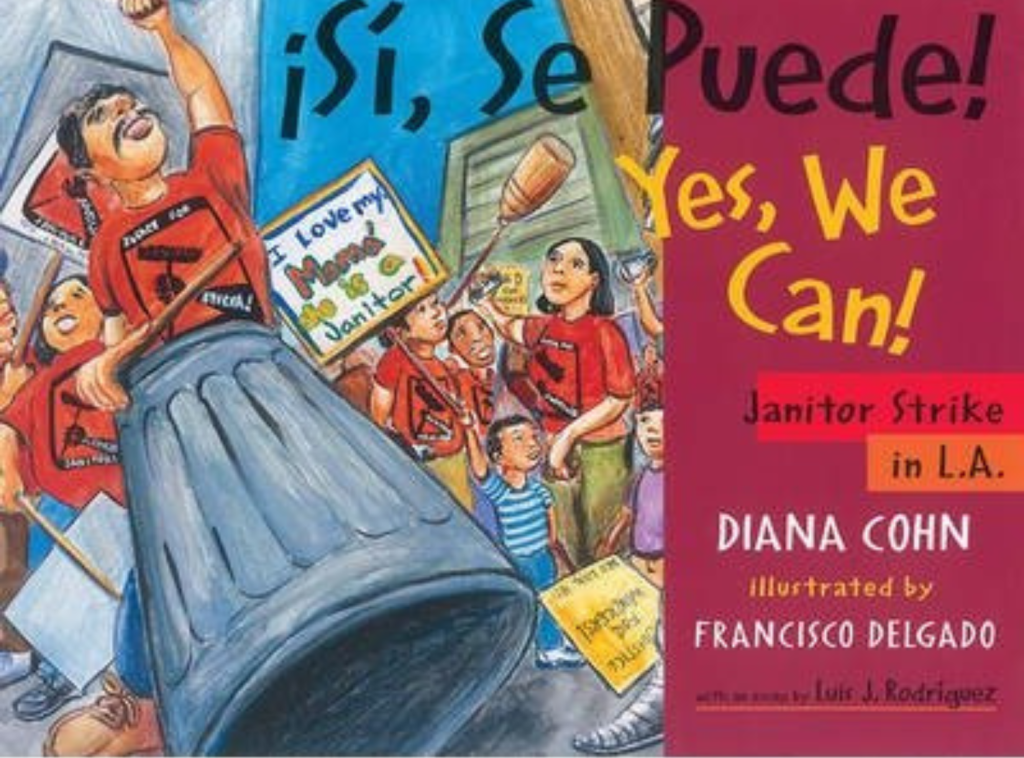
    Si, Se Puede! Yes, We Can!: Janitor Strike in L.A. By Diana Cohn and illustrated by Francisco Delgado.

    Title of book saying “S, Se Puede - Yes We Can!” about the Janitor Strike in L.A. by Diana Cohn and illustrated by Francisco Delgado. It shows a colorful illustration of workers of many races in red shirts protesting with children and families to fight for worker rights.

    Readaloud: https://youtu.be/0ygADdYZ624?si=hW5BeMbcpH3_G_Wf

    Readaloud book only: https://youtu.be/uONnW5SoaGE?si=cTLXMmPXZY_mprvD

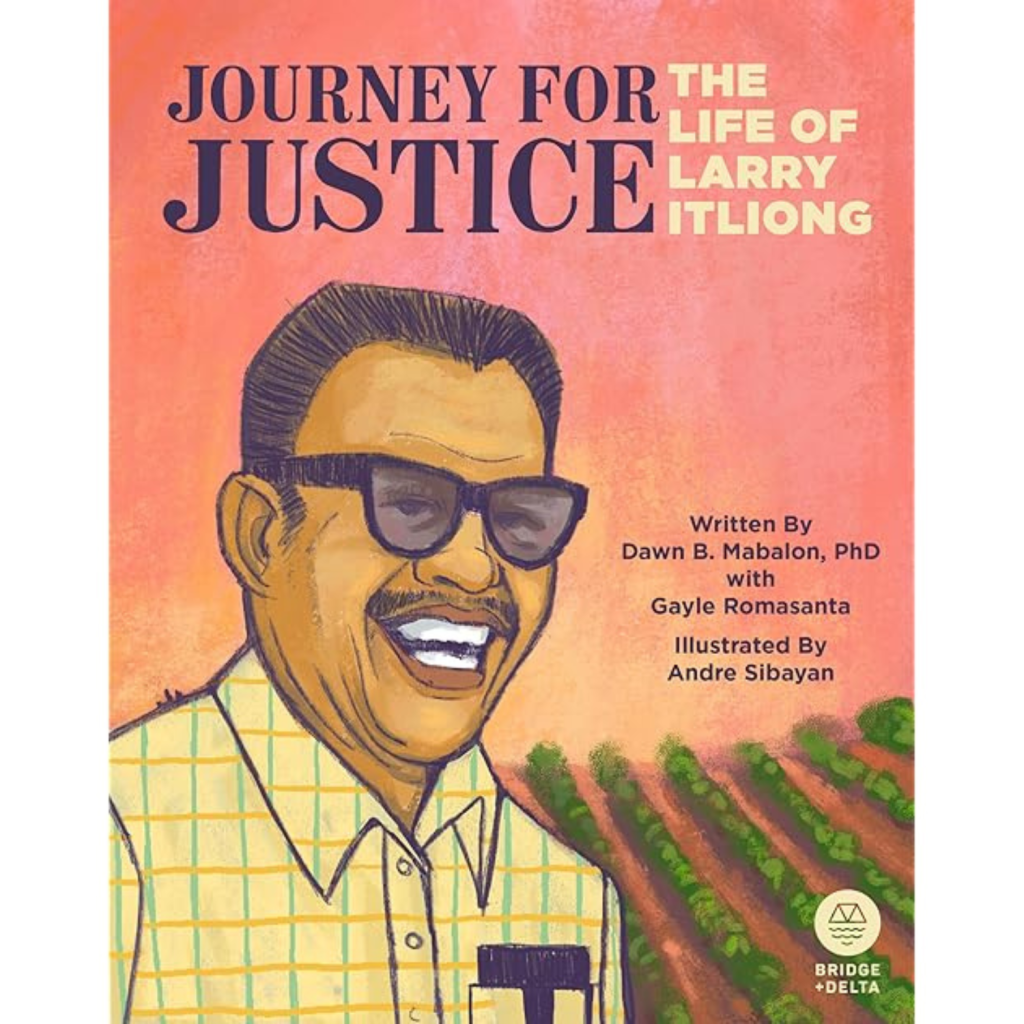
    This is a book cover with the title: “Journey for Justice - The Life of Larry Itliong” by Dawn B. Babalon, PhD and Gayle Romasanta. Illustrated by Andre Sabiyan. It shows a colorful illustration of labor leader, Larry Itliong, a Filipino many in glasses and short hair smiling in front of a peachy colored background and green rows of argiculture in the background.

    Journey for Justice: The Life of Larry Itliong by Dawn Bohulano Mabalon, Gayle Romasanta

    Readaloud: https://youtu.be/jTl17BnAaPk?si=8nH96hGqTDeIqmcO

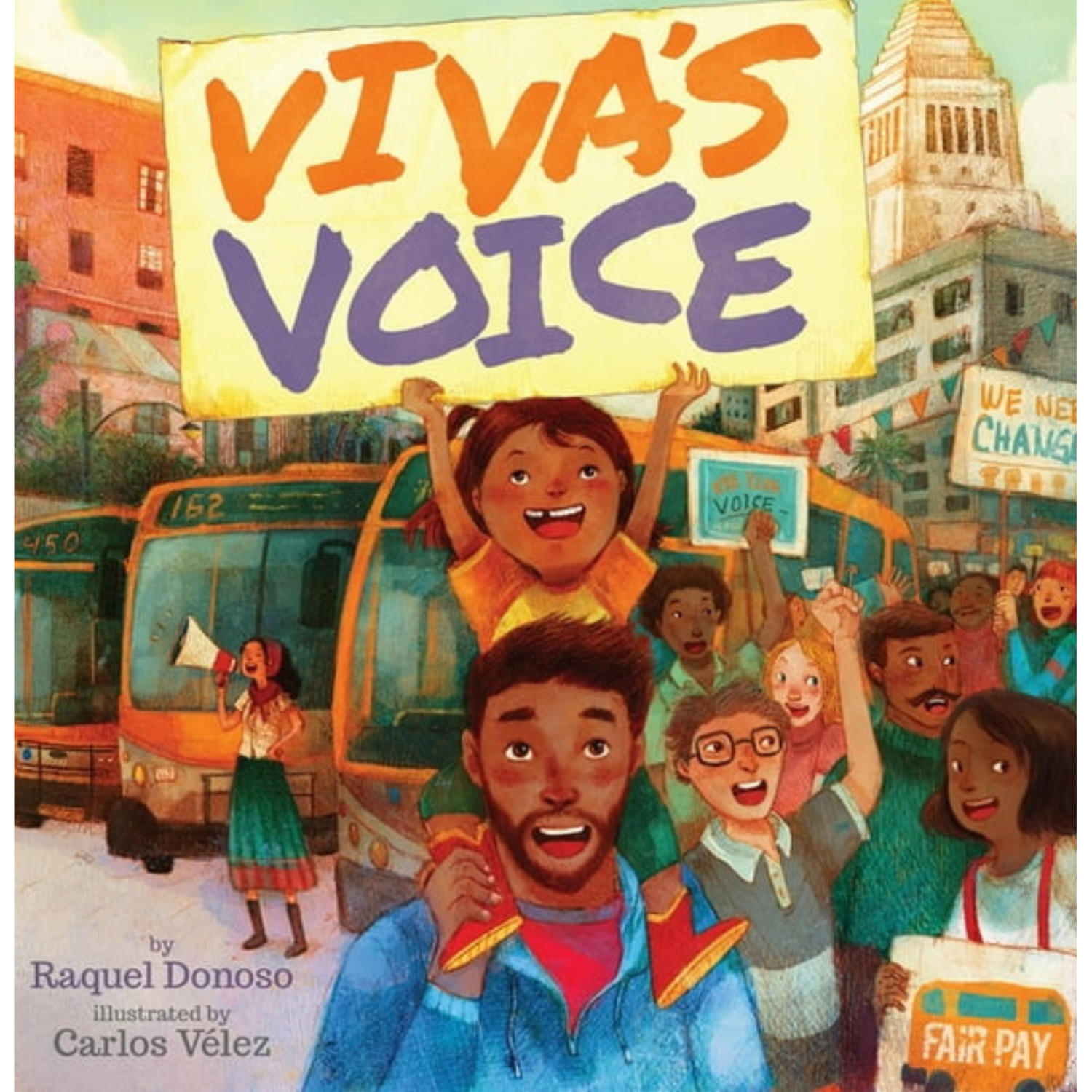
    This is a book cover titled: “Viva’s Voice” by Raquel Donoso and illustrated by Carlos Vélez. It shows a colorful illustration of a brown child on the shoulders of her father holding a sign listing the title of the book. Behind her are people of many racial backgrounds happily chanting strike slogans in front of busses. Some of theri signs ask for change and air pay.

    Viva’s Voice by Raquel Donoso, illustrated by Carlos Velez.

    Readaloud: https://youtu.be/_4FIxkv_STM?si=6IlJ1BGh0VTL0Hz_

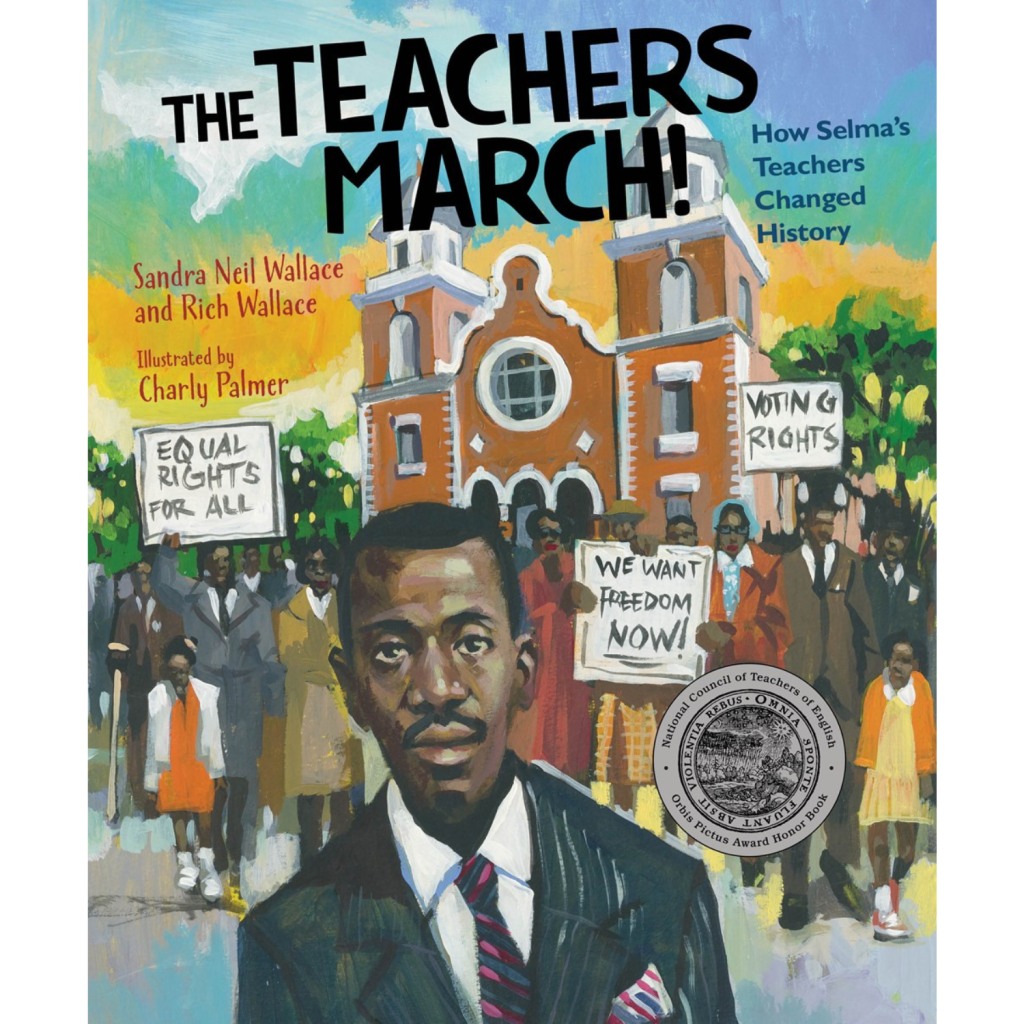
    This is a book with the title: “The Teachers March! - How Selma’s Teachers Changed History” by Sandra Neil Wallace and Rich Wallace and illustrated by Charly Palmer. It shows a beautiful illustration of Black people holding signs saying “Equal Rights for All”, “We Want Freedom NOW!” and “Voting Rights.” They are wearing suits and colorful coats and standing in front of Selma City Hall.

    The Teachers March!: How Selma’s Teachers Changed History by Sandra Neil Wallace (Author), Rich Wallace (Author), Charly Palmer

    Readaloud: https://youtu.be/z9rB5AAtiVQ?si=I9HOB33y3QakJvek

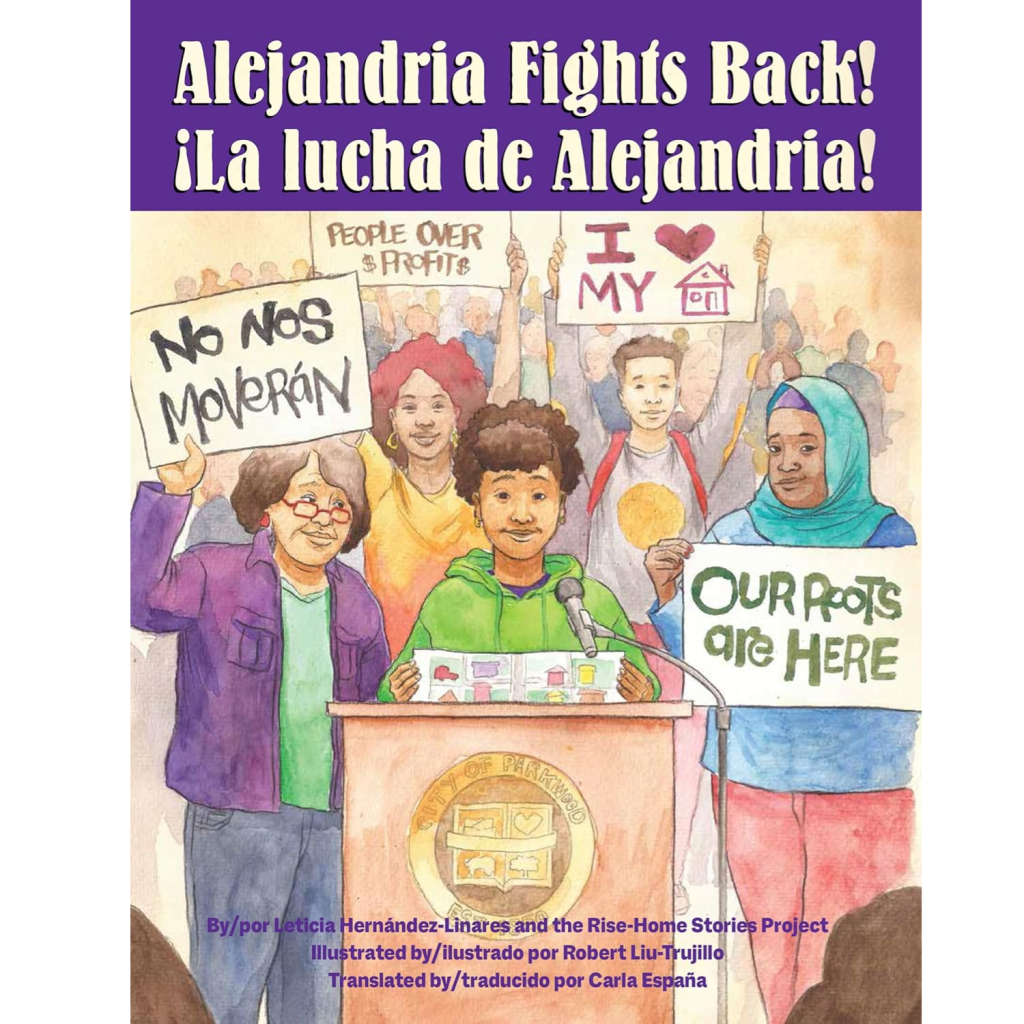
    This is a book titled, “Alejandria Fights Back - La Lucha de Alejandria” by Leticia Hernàndez- Linares and hte Rise-Home Stories Project and illustrated by Robert Liu-Trujillo and translated by Carla España. It shows an illustration of a young brown girl speaking behind a podium with people of all races holding signs that read “no Nos Voverán”, “People Over Profit”, “I Heart My Home” and “Our Roots are Here."

    Alejandria Fights Back! / ¡La Lucha de Alejandria! by Leticia Hernández-Linares (Author), The Rise-Home Stories Project (Author), Robert Liu-Trujillo (Illustrator), Carla España (Translator) (BILINGUAL SPANISH)

    Readaloud: https://youtu.be/adPhiVroya0?si=–Xq9ocRRRkdtOPN

    I understand all these read alouds are in English, and may be limiting for the language your child reads and learns in. Please take this list as a beginning and feel free to find more books on Union power and organizing.

    SF Based Parent Resources are listed below:

    If you are a parent in SFUSD please email through this link: https://actionnetwork.org/letters/san-francisco-families-educators-and-community-demand-stable-schools-now?source=direct_link&

    Please consider adopting a picket at your school site: https://docs.google.com/forms/d/e/1FAIpQLSelkCrL0Xp53Fbn8KEsejhJK9bSqYtR-l5uSG7zip2EpVM-KA/viewform

    Do you have more tips to recommend? Share them in the comments below!

  • Advice for Members of the Global Minority (aka: White Folks) During These Troubling Times

    If you’re a white person who cares about the global majority, there’s a good chance content on social media platforms will spark something in you. In fact, that’s the purpose: to get you enraged and engaged. You’ll probably feel compelled to take action—and that’s not a bad thing. But if you haven’t already done a lot of work unpacking the ways you’ve been indoctrinated into whiteness, it’s important to ensure your activism doesn’t cause more harm.

    Some advice on what NOT to do:

    Forgiveness isn’t yours to give.

    It’s not your job to soften criticism of MAGA folks who are just now seeing the error of their ways. Nor is it your job to counsel people who’ve been harmed to forgive the abuse they’ve suffered in order to “bring both sides together.” Forgiveness is not yours to give—those who caused harm have to do the work to earn it from the communities they’ve hurt.

    Don’t be a white savior.

    Just because you’re waking up to this reality doesn’t mean others haven’t been working on it for much longer. This is not your opportunity to become a white savior or start a new nonprofit. Doing so only colonizes the resistance and takes vital resources, attention, and energy from people with far more knowledge and experience. They have already analyzed the issues, the researched histories, and built communities invested in solving problems. Jumping in to lead a project on a subject you just recently learned about is classic white supremacist behavior.

    Enough with the Pussy Hats and Safety-Pins!

    Wearing jewelry or selling merch “for the cause” is capitalism, not community care. Stop colonizing the resistance. Real activism is about what you DO, not what you WEAR. Just stop.

    Advice on what to DO:

    Take a pause.

    Ask yourself why you need to respond immediately to a problem as old as time. What is happening in you that’s making you feel the need to react. Is the action you want to take truly supporting those being harmed, or does it just make you feel better? A notebook can be a really helpful tool for these kinds of reflection. (Be sure to check out solid resources for unpacking whiteness listed at the end of this article!)

    Look to folks who are already doing the work.

    Listen to and support the needs of Black and Native American organizers, low-income, disabled, and immigrant leaders of color, and queer and trans activists of color.

    Did you see the movie The Help? I didn’t. But that’s what you need to be now. Be. The. Help. You’re not the hero of this story.

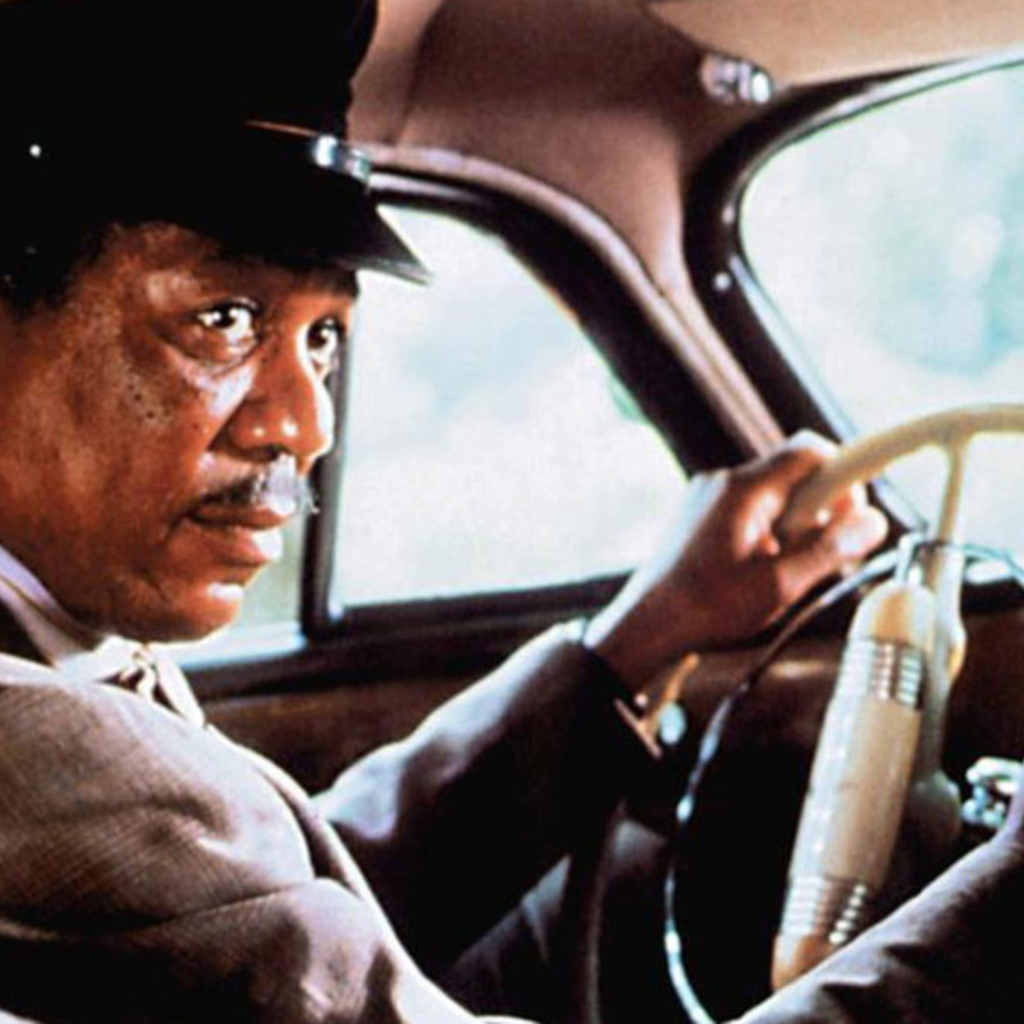
    If your role in this movie was Driving Miss Daisy, you would be the driver, and no, you do not get to assume the role of “magical black Negro.” What I’m trying to say her is you are a side character—you don’t have a character arc or a prominent plot line.

    In fact, I take it back. You’re not even a side character. You’re behind the scenes. You’re the gaffer, the person in charge of lighting scenes. You’re the intern getting coffee. The production assistant taping down cables so the actors don’t trip. You are Kraft services, providing food.

    This might feel uninspiring because you grew up watching movies where Tom Cruise goes to Japan and becomes a better samurai than Japanese people who have trained their entire lives to be samurai. (Seriously?) You’re role is not meant to be inspiring—that’s the point.

    Some ideas…

    This actually not that hard, but for some reason, y’all seem to have a lot of trouble thinking of ways to help. I know some of you may be asking,

    “But if I’m not starting my own nonprofit or making ‘resist’ T-shirts on Etsy, what do I do?” — random white mom.

    Some ways to actually be helpful: provide rides, bring food, offer free childcare, donate professional services like research, graphic design, video editing, and website support. Offer to take meeting notes, make flyers, create surveys, write emails for newsletters, reserve venues, provide IT help, provide food, donate laptops and printers, or help get copies made. That’s how you support.

    Do you know someone who needs to read this article? Send to a friend!! Support our work by signing up for the newsletter. Better yet, become a subscriber and help fund our work!

    Are you a member of the global majority with advice to share? Please comment below!

  • “Stay-at-Home-Sons”,

    “Stay-at-Home-Sons”,

    The Mainstream media propaganda machine is in overdrive.

    by Ali Collins, | January 29, 2026

    A recent Washington Post article asks: Can you still be a real man if you live with your mom? In an article titled “Stay-at-home sons are here—and they’re not going anywhere,” author Shane O’Neill debates the merits of men moving back home. Apparently, this new phenom began after Jeopardy champ Brendan Liaw jokingly listed his profession as “stay-at-home-son,” and the moniker went viral.

    Full disclosure: I don’t love mainstream news. Too often, it’s clickbait for boomers about “kids these days.” This article proved even less insightful.

    The Masculinity Crisis

    The grand thesis: men are moving home, at a time when America is in the throes of a full-blown “masculinity crisis.”

    OK, I’m not a man… but is this REALLY what folks are worried about right now? (cough, cough… GREENLAND, MINNEAPOLIS, cough, cough… EPSTEIN…)

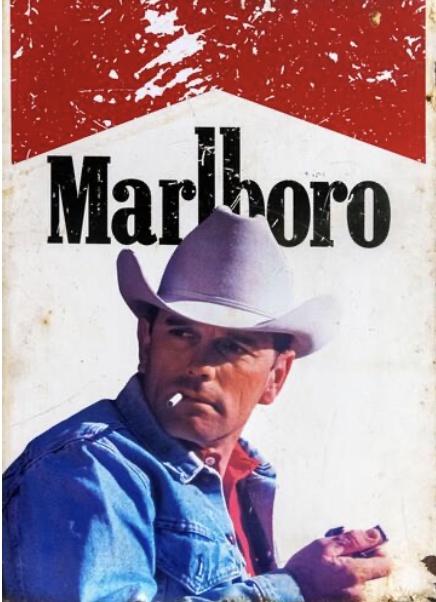
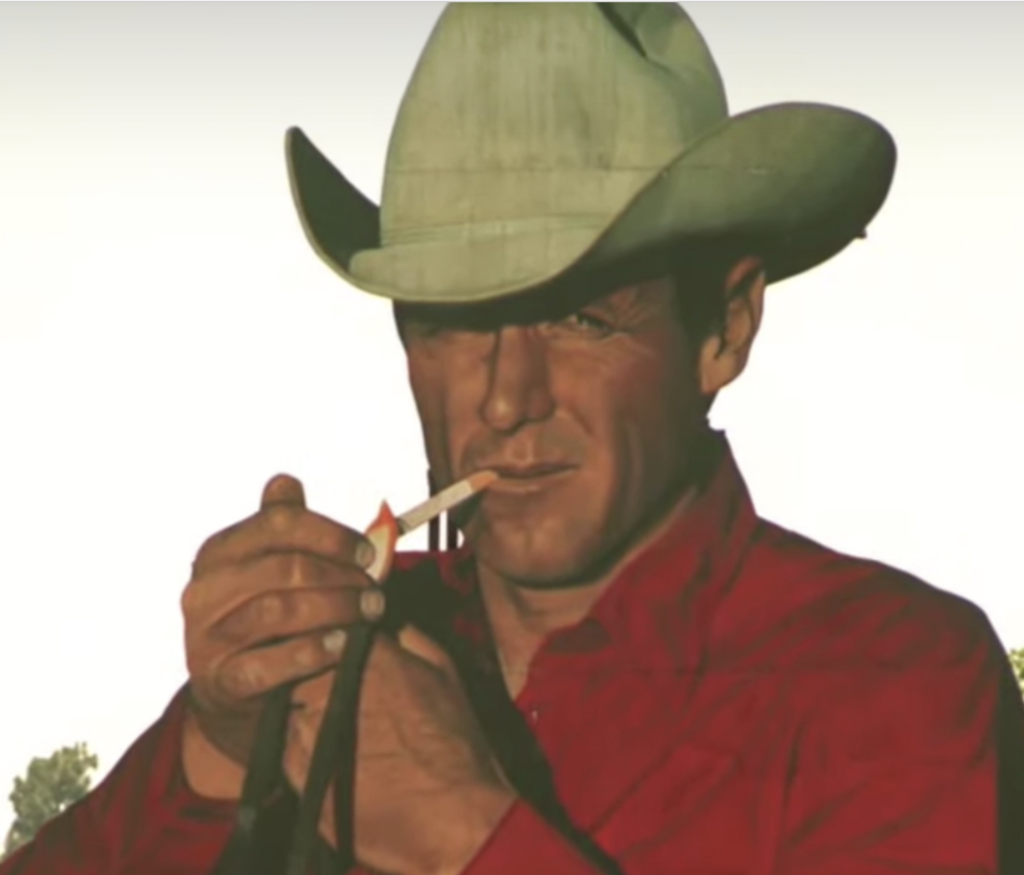
    Yet, somehow, national panic has shifted to men’s jawlines and the “male loneliness epidemic.” The fate of the American man apparently hangs in the balance—especially if he’s living in his childhood bedroom. [Insert: Marlboro Man sobbing into his pillow]

    At this point in the article, I was so annoyed that I had to keep going. As if reading my mind, the author explained this was a “nuanced” conversation. The author then explained that living with one’s parents well into adulthood is considered normal in many non-white cultures. As one interviewee, Che Durena, pointed out, media coverage of stay-at-home dads lacks cultural context. “That’s just called being Italian or Filipino or Indian.”

    What’s missing

    What stood out most was what the author didn’t talk about: Why this “trend” makes sense on multiple levels: 1) the pre-frontal cortex isn’t fully developed until well into one’s twenties; 2) American expectations of moving out at 18 defy human evolution; and 3) it’s fucking expensive! Crippling college debt, a flagging economy, and a constrained job market due to AI automation and the rise of gig”work make it impossible.

    Also lacking was any analysis of how “independence” and “self-sufficiency” are American man myths grounded in both patriarchy and capitalism. After WWII, ad men (and the US government) sold us the idea that real men buy houses, cars, and TVs (and don’t live with mom.) The resurgence of the MAGA movement is now challenging men to live up to standards that may have been doable in the 1950’s, yet are no longer attainable in today’s financial reality. 

    What this propaganda is really about.

    Angry white men were manipulated into voting a reality show felon into office. Their candidate won, and now the chickens are coming home to roost. As more and more Chads can’t afford to buy a condo or get out of college debt, it will inevitably become clearer that no matter how many trans athletes are banned from playing sports, the American Dream is still a pipe dream for most Americans.  The cost of eggs and healthcare continues to rise, and that uppity Black woman who ran for president is no longer in the picture.

    It’s no wonder there’s a masculinity crisis! 60% of white men voted for Trump, along with their pick-me Latino and Asian cousins (55% and 39% accordingly.) They bought the snake-oil ideology of “bootstraps” and “hard work”. One year later, with DEI dismantled and ICE deporting the competition, they are running out of scapegoats.

    There is only one person left to blame—themselves.

    Based on the myth of meritocracy, if you are still struggling despite America Being Great, it means: A.) You actually are a loser; B.) 92% of Black women were right. You were duped by a con artist who protects pedophiles. C.) All of the above. You are not only a loser; you are also an idiot. 

    (Hint: The answer is C.)

    As neither of these conclusions is palatable, mainstream media is pivoting to “stay-at-home-sons”. When immigrants were doing it, it was trashy. Now that white people are doing it’s classy! Prepare for more articles like this and others on “the joys of van life!” (aka: living in your car.)

    What I wish we were talking about.

    And honestly? As a mom, I’m thrilled if my kids stick around. In fact, I consider it a compliment. I have always believed that multi-generational living is more practical, ecological, and economical. After seeing multi-generational living elsewhere, the American obsession with kicking kids out at 18 also seems… kind of sad.

    Maybe, instead of obsessing over masculinity, we could talk about supporting each other—crazy, I know. Unfortunately, with newsrooms purging diverse voices, there will be no more Black, queer, disabled, feminist critiques of popular culture in mainstream media. Instead, enjoy more puff pieces on the “masculinity crisis” and “stay-at-home sons.” How else will the current regime distract the public from crushing debt, skyrocketing inflation, and a precipitous decline in the American quality of life?

    Last summer, I saw an article that seemed to encapsulate where many Americans now find themselves. “I finally achieved the American Dream,” the author wrote, “by moving to Europe.”

    What do you think? Tell me in the Comments below…

    (And if you’d like to start a conversation, consider submitting your thoughts for publication on this blog.)